English - Writing

"If you want to change the world, pick up your pen and write!" - Sir Winston Churchill

Writing Lead - Mrs Rachael Nash
Writing
Intent
At St Dennis Primary Academy, we believe writing is a vital form of communication, creativity and self-expression. It’s central to our curriculum because writing with clarity, purpose and imagination unlocks wider learning, builds confidence and ensures every child has a voice.
From Early Years through Year 6, we are committed to nurturing skilled, motivated writers who adapt their writing for varied audiences and purposes. High‑quality texts remain at the heart of our curriculum, inspiring pupils to recognise and replicate effective writing.
Our approach is rooted in evidence, including the EEF’s guidance 'Improving Literacy in Key Stage 1 and 2' and the new DfE Writing Framework (July 2025), which emphasise:
Automatic transcriptional fluency: secure handwriting and phonics‑based spelling from Reception, enabling cognitive load to shift toward composition
Sentence‑level instruction embedded in context: teaching grammar, punctuation, vocabulary, and sentence structure within real writing, rather than in isolation
Oral composition preceding written work: encouraging pupil talk‑for‑writing and sentence rehearsal to scaffold planning and refine ideas
Focus on quality, not quantity: resisting early pressure for long pieces in Reception and prioritising precise, fluent, meaningful writing
Early identification and support: providing timely interventions for pupils struggling with transcription or composition skills
It is our intention, that by the end of their primary school journey at St Dennis, our pupils will:
Write fluently and confidently for diverse audiences and purposes;
Organise and structure ideas effectively, using accurate spelling, grammar, and punctuation;
View themselves as authors with valuable contributions;
Possess the resilience, motivation and metacognitive tools to continue as independent writers, beyond the classroom
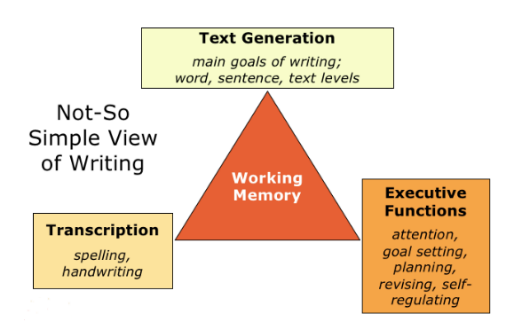
We also embrace The Not‑So‑Simple View of Writing (Berninger), recognising how working memory supports transcription, text generation, and executive functions - reinforcing the importance of automaticity in handwriting and spelling.
At St Dennis, we celebrate every child’s voice. We value the writing process as much as the final product, and we champion creativity, challenge and communication. Our goal is for every child to leave us not only as a capable writer, but as someone who sees writing as a way to share, persuade, explore and inspire.
Implementation
Overview
At St Dennis Primary Academy, our writing curriculum is designed to develop confident, fluent and creative writers from the earliest stages of education through to Year 6. Our implementation is underpinned by evidence-based strategies, including the EEF’s guidance on 'Improving Literacy' and the DfE Writing Framework (2025). It is structured, progressive and inclusive, ensuring pupils build secure foundations in transcription and composition while developing metacognitive awareness and independence.
The Early Years Foundation Stage (EYFS)
The EYFS is a critical foundation stage for writing. Our focus is on:
Gross and fine motor development to support handwriting fluency.
Automatic transcriptional skills through:
Structured handwriting activities.
Read Write Inc. (RWI) phonics and writing.
Continuous provision writing opportunities.
Oral composition and sentence rehearsal before writing.
Drawing Club to integrate storytelling, vocabulary, and mark-making in an engaging, creative context.
Children progress from mark-making to forming letters and constructing simple sentences, prioritising quality and accuracy over quantity.
Key Stage 1
Writing instruction in KS1 builds on EYFS foundations through:
Daily RWI Get Writing lessons for transcription and sentence-level work.
Drawing Club for creativity and oral rehearsal.
Talk for Writing introduced in Year 2 Summer term.
SPaG is taught in context and reinforced through:
Quick Writes – focused application of sentence-level grammar and punctuation.
Talk for Writing – structured genre-based writing.
Key Stage 2
KS2 consolidates and extends writing skills through:
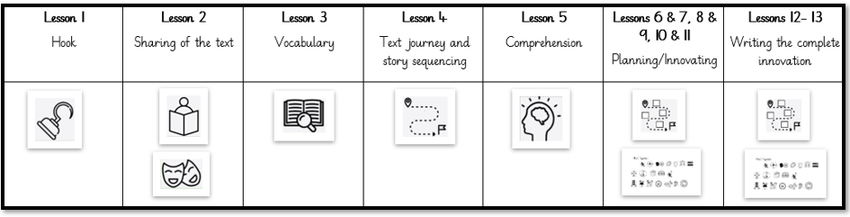
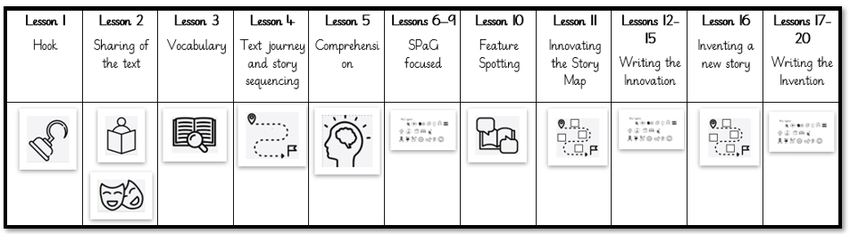
Talk for Writing units linked to curriculum topics for purposeful writing.
Quick Writes – targeted SPaG practice.
Whole-class and 1:1 conferencing – accelerating progress and supporting pupils to reach greater depth.
Pupils learn to write for a range of purposes and audiences, using increasingly sophisticated grammar, vocabulary, and cohesive structures. Editing and redrafting are integral to the writing process.
Spelling, Punctuation and Grammar (SPaG)
SPaG is taught through:
RWI Phonics and Spelling (EYFS to KS2).
Discrete SPaG lessons embedded within writing contexts.
Application in purposeful writing tasks.
The RWI Spelling programme continues into KS2, with pupils grouped by need and assessed regularly. Each child has a spelling log book and access to the Extra Practice Zone for home learning.
Handwriting
 Handwriting is taught using the Nelson Handwriting Scheme, progressing from letter formation in EYFS to fluent, joined handwriting in KS2. Lessons are sequenced to ensure consistency, legibility, and speed, supporting automaticity and reducing cognitive load.
SEND Provision
At St Dennis Primary Academy, children with SEND are fully included in the life of the school, their needs are understood so that the right adjustments and provision are in place and staff have high expectations which ensures children aspire to be successful in their learning and make good progress. This is because ‘Everyone matters, everyone succeeds and every moment counts’. We have identified strategies to support children with specific areas of need.
At St Dennis we implement Colourful Semantics from Nursery though to Year 6 to enhance pupils' understanding of sentence structure, grammar, and communication. This is a visual strategy that uses colour-coded cues to support language development. Each part of a sentence is associated with a specific colour, helping children to identify and structure key components of a sentence, such as:

Additional elements, such as adjectives, connectives or time phrases, can also be introduced in later stages with their own colours. It also helps develop narrative skills, understanding of written text, answering questions, developing vocabulary and using nouns, verbs, prepositions and adjectives.
Impact
By the time children leave St Dennis Primary Academy, they are confident, fluent and motivated writers who understand the power of writing as a tool for communication, creativity and self‑expression. They write with increasing accuracy, control and purpose because they have developed secure transcriptional skills from the earliest stages — a key expectation within the DfE Writing Framework, which identifies automaticity in handwriting and spelling as essential for freeing cognitive capacity for higher‑quality composition.
Our emphasis on high‑quality talk, oral rehearsal and rich reading experiences ensures that pupils can articulate, shape and refine their ideas before writing, in line with the framework’s principle that spoken language underpins written composition. This supports stronger sentence construction, greater vocabulary choice and more deliberate authorial decision‑making.
As pupils move through the school, they learn to draft, edit and improve their writing with growing independence. This reflects national guidance, emphasising that high‑quality writing emerges from deliberate practice, revisiting and reworking — leading to “fewer but better‑crafted outcomes.”
Because we identify and support pupils who need additional help early, no child is left behind in developing the fluency, stamina and confidence needed to succeed. This aligns with the DfE’s focus on early support and targeted intervention to prevent gaps widening over time.
As a result, pupils at St Dennis Primary Academy:
- Write with clarity, accuracy and increasing sophistication across a range of genres and subjects, demonstrating secure sentence instruction and strong foundational skills.
- Understand themselves as authors who can craft writing for different audiences and purposes.
- Apply their writing skills confidently across the curriculum, enabling success in the wider learning journey and ensuring readiness for the demands of Year 7 and beyond, as outlined by national expectations.
- Leave us with pride in their achievements and a belief that their voice matters.
Ultimately, the impact of our writing curriculum is that every child leaves St Dennis as a capable, creative writer who can communicate with confidence — someone who not only knows how to write, but who understands why writing matters.
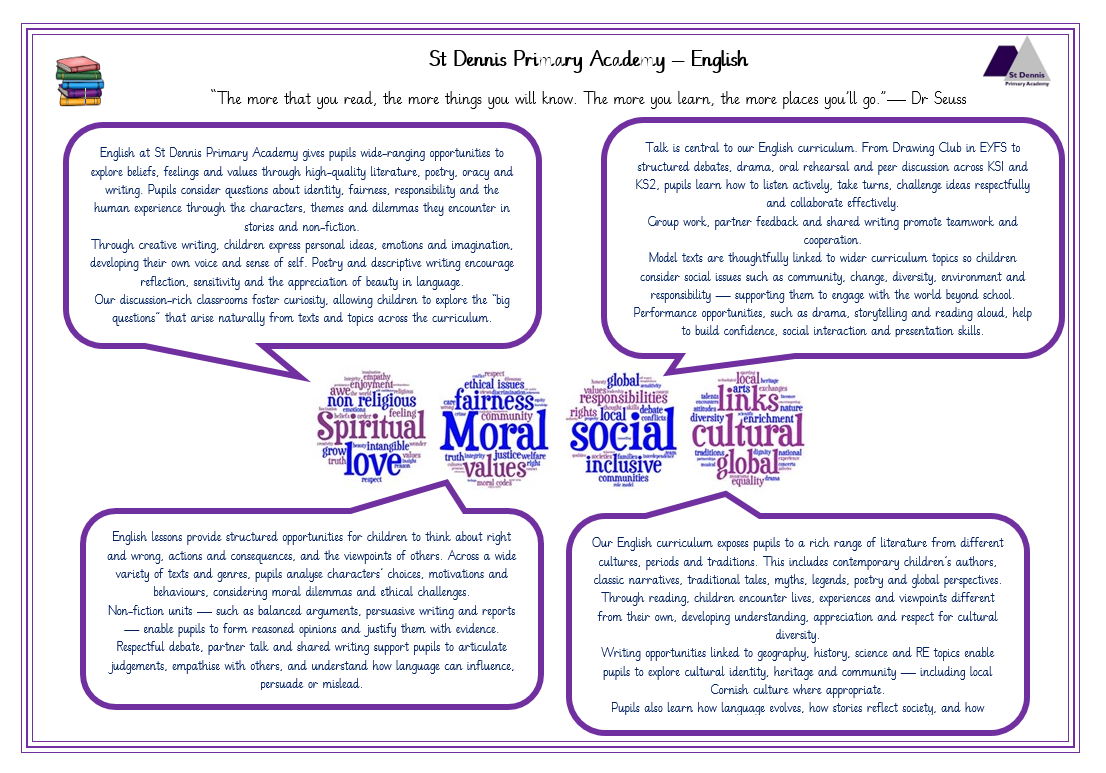
How SMSC threads through our English offer
- EYFS & KS1: Drawing Club, storytelling, role play, high‑quality picture books and oral rehearsal give pupils foundations in empathy, cooperation, imagination and emotional expression.
- KS2: Longer texts and topic‑linked units support deeper discussion of complex themes such as justice, belonging, aspiration, equality, resilience, conflict and environmental responsibility.
- Whole school: Oracy expectations, vocabulary teaching, sentence‑level work, poetry and cross‑curricular writing foster thoughtful communication and shared understanding.
- SEND provision: Approaches such as Colourful Semantics, pre‑teaching vocabulary and structured talk enable all pupils to access SMSC elements through language and story.